

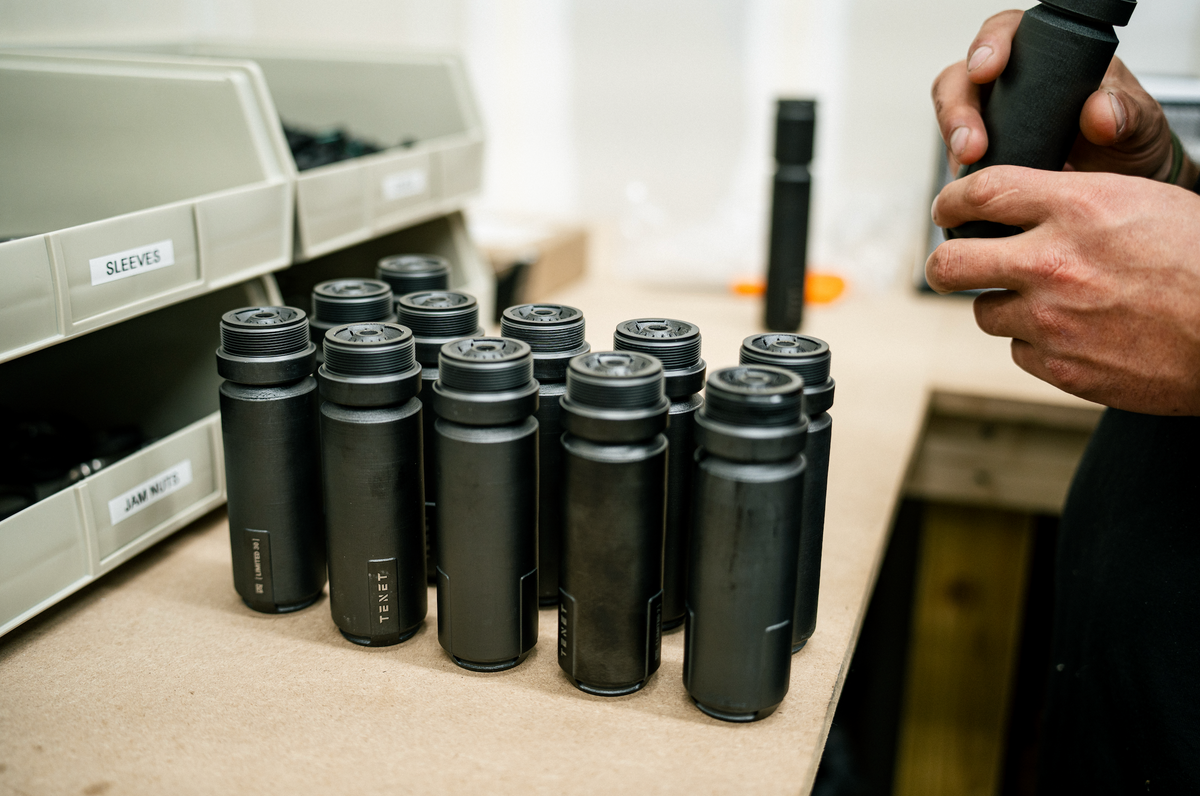
When most people think about a suppressor, they probably picture a simple tube with a series of baffles inside.
And traditionally, that's not too far off.
For decades, suppressor manufacturers have largely been limited by the way a product could be made. Parts needed to be machined. Tools needed physical access to the areas they were cutting. Internal features had to be designed around what a CNC machine could actually reach.
That works. It's also how a lot of great suppressors have been made.
But it creates limitations.
At TENET, we use additive manufacturing because it allows us to approach suppressor design from a different direction.
Instead of starting with:
"What can we manufacture?"
We can start with:
"What would perform the best?"
Then we figure out how to build it.
Traditional Manufacturing Comes With Rules
Think about machining a complex part.
A cutting tool has to physically reach the material. Certain angles are difficult to machine. Internal features can require multiple components. Sometimes, the best theoretical design simply isn't practical to manufacture using traditional methods.
That means engineers often have to make compromises.
Maybe a feature gets simplified because it's too difficult to machine. Maybe the part has to be made from multiple pieces and assembled together. Maybe material has to stay in an area simply because removing it would make the manufacturing process more complicated.
None of those decisions are necessarily about performance.
They're about manufacturing.
And that's where additive manufacturing changes the conversation.
Built Layer by Layer
With additive manufacturing, the suppressor is built layer by layer using a metal 3D printing process.
That opens up a tremendous amount of design freedom.
We're no longer limited to designing internal geometry around whether or not a cutting tool can physically reach it. Complex shapes, internal pathways, and structures can be created as part of the manufacturing process itself.
In simple terms, we can spend less time asking whether something is possible to make and more time asking whether it actually improves performance.
That doesn't mean there are literally zero limitations. Every manufacturing process has rules.
But compared to traditional manufacturing, additive manufacturing gives us far fewer constraints when it comes to the geometry we can explore.
And when you're trying to manage the incredible amount of energy and gas produced by a rifle cartridge, geometry matters.
A lot.
The Inside Matters
From the outside, a suppressor might look simple.
The interesting stuff happens inside.
Every shot sends high-pressure gas into the suppressor. What happens next depends heavily on how that gas moves through the internal structure.
Where does it go?
How quickly does it move?
How does it expand?
How does the suppressor manage that energy before it exits the muzzle?
Those are the types of questions that drive suppressor design.
With additive manufacturing, we're able to explore complex internal geometry and gas pathways without being forced into the same design constraints that come with machining traditional components.
That freedom gives us more room to experiment, refine, test, and continue pushing toward better performance.
Performance Doesn't Have to Mean More Weight
One of the biggest misconceptions in suppressor design is that more material automatically means more performance.
Sometimes, adding size and weight can help with certain goals.
But every ounce you add to the end of a rifle comes with a tradeoff.
A heavier suppressor can change how a rifle balances. A longer suppressor can make the overall package more cumbersome. For a hunter carrying a rifle all day, those things matter.
The goal isn't simply to make the biggest suppressor possible.
The goal is to make every ounce count.
Additive manufacturing gives us more control over how material is used throughout the design.
Instead of treating the suppressor like a solid piece that has to be machined away, we can build the structure intentionally. Material can be placed where it's needed to support the design and contribute to performance, without carrying unnecessary material simply because of the limitations of how the part has to be manufactured.
That ability is a major part of how TENET can pursue high levels of performance while keeping our suppressors lightweight and compact.
More Design Freedom Means More Opportunities
At the end of the day, additive manufacturing isn't magic.
Just because you can 3D print something complicated doesn't automatically mean it will perform better.
Every feature still has to serve a purpose.
That's where the engineering process comes in.
The real advantage is the freedom to explore.
When you're not as restricted by traditional manufacturing methods, you have more opportunities to test different ideas. You can look at geometry that might be extremely difficult—or even impossible—to produce through conventional machining.
Then you can evaluate it based on what actually matters.
Does it manage gas better?
Does it improve recoil control?
Does it help reduce weight?
Does it contribute to the overall performance of the suppressor?
If the answer is no, there's no reason for it to be there.
If the answer is yes, additive manufacturing gives us more freedom to incorporate that idea into the design.
Designing Around Performance, Not Manufacturing
That's really what it comes down to.
Traditional manufacturing often requires the design to work around the manufacturing process.
With additive manufacturing, we're able to flip that approach.
We start with performance.
We look at the problem we're trying to solve. We explore the geometry. We evaluate how the internal design manages the energy and gas produced with every shot.
Then we build around the solution.
Again, additive manufacturing still has its own design considerations and constraints. But the amount of freedom it gives us compared to conventional manufacturing opens the door to designs that would otherwise be much harder to create.
And that's important to us.
Because the goal at TENET has never been to use additive manufacturing just because it's new or because it sounds impressive.
We use it because it gives us another tool to pursue better performance.
Maximum Performance. Minimum Unnecessary Weight.
Every TENET suppressor starts with the same basic idea:
What can we do better?
Sometimes, the answer is in the way we manage gas.
Sometimes, it's in the geometry.
Sometimes, it's about finding ways to remove unnecessary weight without sacrificing the performance we're after.
Additive manufacturing gives us the freedom to explore all of those things.
Layer by layer, we can build complex designs that aren't restricted to the same shapes and limitations of traditional manufacturing.
That means more freedom to engineer.
More freedom to test.
And more freedom to focus on what matters when it's time to pull the trigger.
Performance. Control. And no unnecessary weight along for the ride.
At TENET, we're not interested in designing around the limitations of yesterday's manufacturing.
We're interested in finding out what's possible when performance comes first.

![GunsAmerica - Say Goodbye to Recoil - TENET [LIMITED 30] Suppressor Review](http://www.tenet.inc/cdn/shop/articles/IMG_0321_55efb65b-5c3a-42f5-949b-8b47b55b1389.jpg?v=1790628982&width=1280)

Share:
Why We Chose Direct Thread
More Than a Finish: The Science Behind a TENET Suppressor That Lasts