

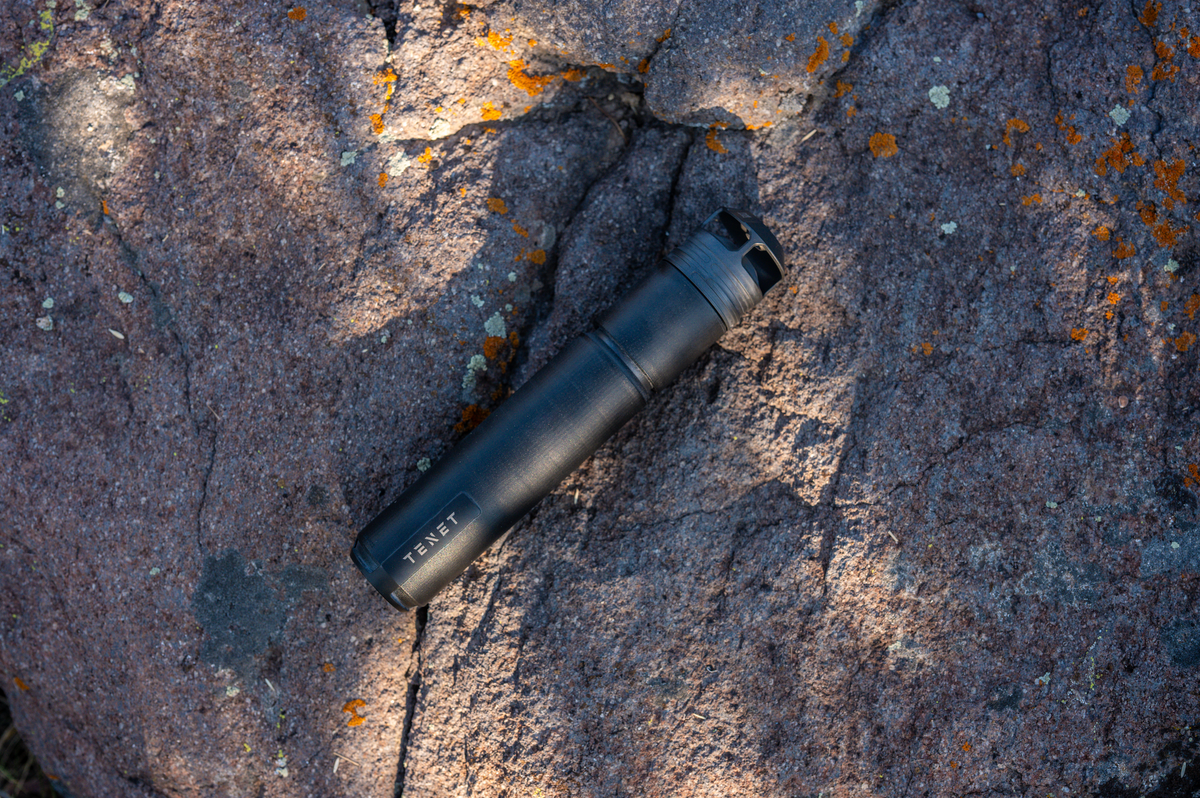
A suppressor goes through a lot. Heat. Carbon. Weather. Brush. Rocks. Miles in and miles out. It gets mounted, dropped in a pack, dragged through brush, run hot round after round, and expected to keep performing like day one. So when it came time to decide how we'd finish TENET suppressors, we weren't looking for something that simply looked good. We wanted something built for the job.
Every suppressor looks solid on the outside. But what actually determines how long a can survives — and how easy it is to live with — happens at the microscopic level, long before it ever gets mounted on a barrel. That's why we don't just machine and finish our cans — we put every unit through a five-stage treatment process, centered on PVD (Physical Vapor Deposition) coating technology, designed to fight wear at every stage of its life.
Here's what actually happens to a TENET suppressor before it ever reaches you.
1. Deep Ultrasonic Cleaning
Before any coating goes on, every component takes a bath — literally. We run each part through an advanced ultrasonic cavitation bath, where high-frequency sound waves generate microscopic bubbles that implode against every surface, including the deepest, hardest-to-reach baffle pockets. This process pulls out manufacturing oils and micro-contaminants that would otherwise sit between the metal and any coating applied afterward.
Why does this matter? Because a chemical bond is only as good as the surface it's bonding to. Skipping this step is like painting over dust — it might look fine on day one, but it won't hold up. Starting with a truly pristine surface is what makes every following stage actually work.
2. Metallurgical Interior Conditioning
Centerfire cartridges create a genuinely violent internal environment — a blast of hot gas, unburnt powder, and pressure spikes, all contained in a relatively small metal core. To handle that, we treat the internal metal itself, not just its surface finish.
This conditioning process serves two purposes at once. First, it drastically reduces baffle erosion caused by unburnt powder particles slamming into the interior surfaces round after round. Second, it increases the tensile strength of the core, so it can better absorb extreme pressure spikes without fatiguing over time. It's a structural upgrade as much as a protective one.
3. Self-Cleaning, Carbon-Shedding Interior
If you've ever owned a suppressor with a raw metal interior, you know the drill: carbon builds up, it's porous, and eventually you're stuck soaking baffles in solvent to get anywhere close to clean.
We solve this with an ultra-thin, high-temperature interior coating that creates a slick, non-porous barrier carbon simply can't grip onto. Instead of accumulating layer after layer, fouling gets swept along by the natural gas velocity moving through the bore.
The payoff: you never have to chemically soak the interior of the can. The suppressor effectively cleans itself as you shoot it.
4. Diamond-Tough Exterior Armor, Applied with PVD
The outside of a suppressor takes its own beating — thermal cycling, scratches from cases, holsters, and hard use in the field. This is where PVD (Physical Vapor Deposition) does its work. PVD applies an ultra-thin, durable coating inside a controlled vacuum environment, bonding it to the metal at a molecular level rather than simply spraying it on.
That process is what gives our exterior coating far superior wear and scratch resistance compared to industry-standard Cerakote — without adding unnecessary bulk or changing the suppressor's dimensions. For a can built around lightweight performance, that matters: even the finish is designed with weight in mind.
The result holds up under extreme thermal cycling, too. It won't bake off, discolor, or wear down to bare metal after repeated hot-and-cold cycles the way lesser finishes do. This is the coating that keeps a suppressor looking — and performing — like new well after hundreds of rounds through it.
5. Anti-Seize Thread Protection
Here's a problem most shooters have experienced firsthand: extreme heat causes thermal expansion, and thermal expansion can weld threads together. Suddenly your suppressor won't budge off the mount, and you're fighting corrosion and galling with tools you shouldn't need.
We treat the mounting threads specifically to resist corrosion and seizing, preventing metal-on-metal galling for good. The result is a can that threads on and off smoothly, shot after shot, session after session — no anti-seize paste, no fighting a stuck mount, no drama.
The Bottom Line
None of these five stages exist in isolation — they build on each other. A clean surface makes the coatings adhere properly. A stronger, more erosion-resistant core supports everything built on top of it. A carbon-shedding interior and a scratch-proof exterior work together to keep the can performing like new. And thread protection means none of that matters if you can't actually get the suppressor on and off your firearm.
The result is a suppressor that's engineered to perform less like a wear item and more like a permanent part of your setup — built for more than the range, and ready for unrivaled shot control wherever the miles take you.

![GunsAmerica - Say Goodbye to Recoil - TENET [LIMITED 30] Suppressor Review](http://www.tenet.inc/cdn/shop/articles/IMG_0321_55efb65b-5c3a-42f5-949b-8b47b55b1389.jpg?v=1790628982&width=1280)
Share:
How Additive Manufacturing Helps TENET Push Suppressor Performance Further
GunsAmerica - The Quietest Suppressor We’ve Ever Tested!